
The full story
Selection
I was 18 when I went into selection for an Air Force commando unit. The kind that works behind enemy lines.
Five hell weeks, one after the other, and each one cut the group down.
Here's what surprised me. Selection wasn't looking for the strongest guy in the room. It was looking for the one who, under maximum personal pressure, steps back to help someone else.
When my service was done, I left. Solo, on motorcycles, bicycles and 4x4s, through 18 countries: remote parts of Europe, the Middle East, China, Australia, New Zealand, India and North America. I climbed peaks and frozen waterfalls, rappelled into canyons, explored caves, skied, and took to the sky.
It took me years to see what selection had shown me. Pressure doesn't build character. It shows you what's already running.
Building, losing, rebuilding
I studied business and marketing at Oxford Brookes University in England. Then real estate, in New Jersey and Florida.
In 2004 I moved to British Columbia with my wife and our first daughter. New country. Start again.
Real estate became my business for more than 20 years. Construction, renovation, investment, development.
Then 2007: the marriage ended. The business came close to bankruptcy. I became a single father to two little girls, and for about two years that was the job.
So I rebuilt. The business, the finances, and in time a marriage that works. That's Sonja.
What I took from that period wasn't toughness. It was that the big calls at home and the big calls at work run on the same machinery. Fear. Ego. The story you tell yourself about who you are. You don't get to switch it off at the office door.
November 2010
November 2010. The Coquihalla Highway, in a snowstorm. Black ice.
I lost control. The car hit the concrete median, launched, flipped, and landed on its roof in front of a fully loaded semi-truck.
A second before impact, a message came through, clear as anything: "You are not going to die, but the version of you coming out of this cannot be the same version of you now."
I was trapped in that car for two and a half hours. I broke the steering wheel holding on. I could hear the rescue team as they slowed down: "Chances anybody made it here are slim. So just be careful as you work."
Eight days in an induced coma. Both lungs collapsed. My sternum broke in two places and left my heart exposed. My right femur was fractured in 17 places. Six surgeries while I was still under, more than 20 in all.
They told me I'd never walk again.
The media later called me "the man who refuses to die." It didn't feel like that. It felt like a man on crutches who couldn't work, and couldn't be the father he wanted to be.
2013: the call
For a year and a half we tried to save the leg. Four surgeons. Wheelchair, crutches, and pain that didn't let go. Then I spent about a year researching the alternative before I was ready to decide anything. Three of my four surgeons told me not to do it.
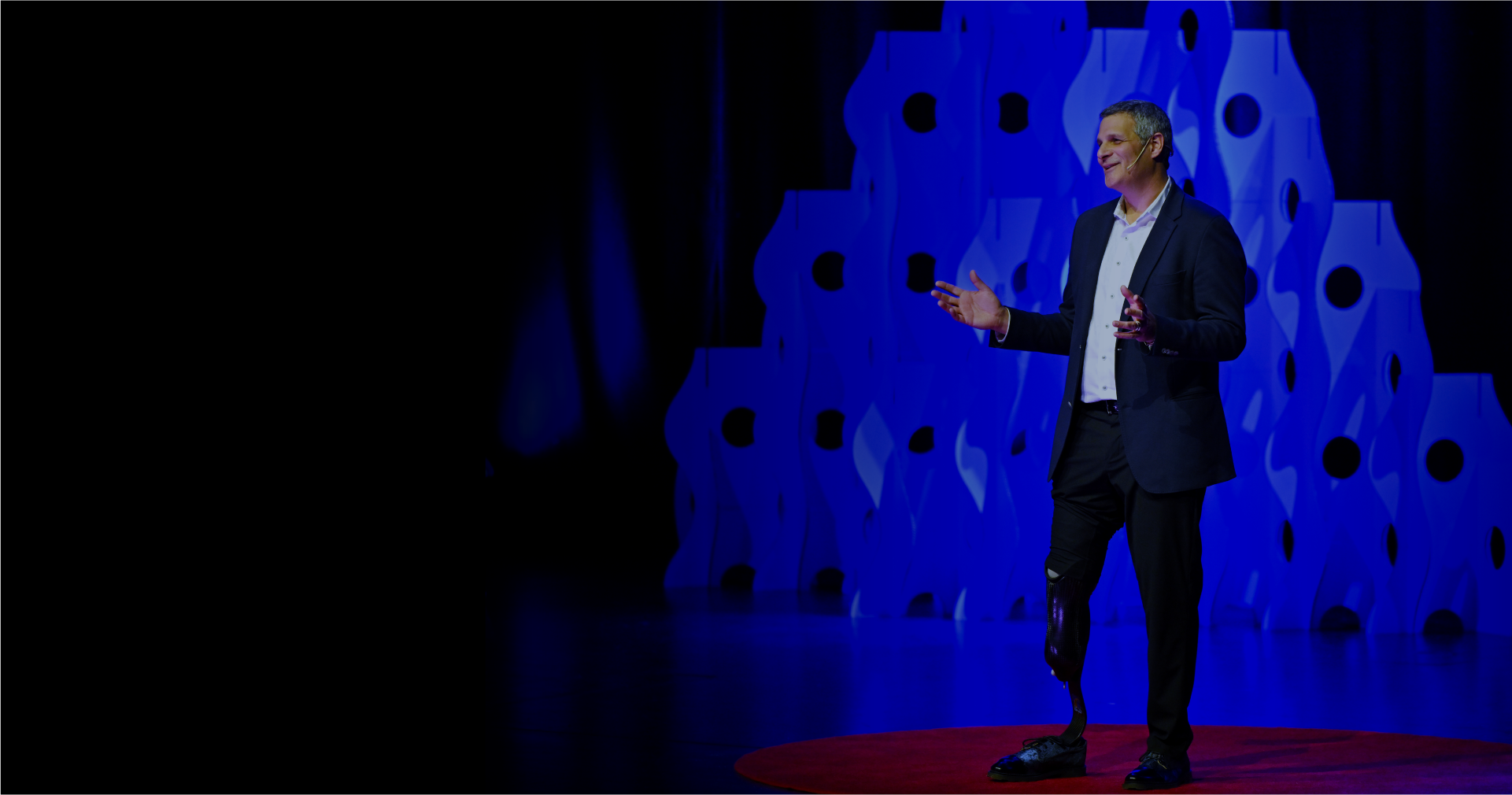
In 2013 I chose to have my right leg amputated below the knee.
The night before, I sat with my daughters and we watched a film about a dolphin with a prosthetic tail. That was how I explained it to them.
Signing the consent form, what I felt was relief. The next day there's a photo of me standing with a big smile. The commando. The indestructible father. Inside I was broken. I thought I'd made the wrong decision.
I walked unassisted the day I got my prosthetic. Rode a bike on day two. Drove on day three.
But the uncertainty didn't leave with the leg. That's the part nobody tells you. You don't get to be sure. So I stopped asking whether I was sure, and started asking something else. Can I live with the outcome?

The desert
Once life settled, I went looking for the next mountain. I trained to ride the Dakar Rally on a motorcycle. I hold an official letter stating that if I competed, I'd be the first amputee in the world to attempt it on a motorcycle. The training got attention: CBC News, CBC Radio One, The Guardian, The Jerusalem Post. My ego was on cloud nine.
Then I crashed in a desert race. It nearly killed me.
That crash made me look at what I'd been doing. I wasn't chasing the Dakar. I was trying to prove I was still the guy from before the accident. And while I fed that story, my business almost went bankrupt.
That's what a story does to a decision. It makes the call for you, long before you look at the facts.

2018, at 45
In 2018, at 45, I had a heart attack. On a chiropractor's treatment table, two blocks from a hospital. That distance is the reason I'm still here.
The cardiologist told me I had a 50% chance of having another heart attack in the next six months.
Here's what I had to own: I'd spent my whole life overriding physical signals for the mission. In the unit. In recovery. In business. The thing that made me tough had become my blind spot.
Your state isn't a side issue. It's what you bring to every decision: the sleep you didn't get, the pressure you're carrying, the fear you won't name.
A cat gets nine lives. I have 6 left. So I wasted three.
Decoding decisions
So I went looking for how decisions actually work.
I went deep into the research on decision-making under pressure. Klein, Kahneman, Endsley, Boyd and Weick. I brought in what my body had taught me too. Krav Maga in the military, Aikido before the accident, Qigong after it.
One pattern kept coming back. Most delay isn't an information problem. The decision is often already made somewhere inside. What gets delayed is the doing.
About seven years ago I changed careers completely. Since then I've worked with owners and leadership teams, testing and refining one model on the decisions they keep putting off.
It's called the Resilience Edge Operating System. It runs on four protocols:
- Story. Own the narrative running your decision.
- State. Optimize the capacity you bring to the decision.
- Decision. Name the bias, run the audit, make the call.
- Ownership. Put a name on it, make the decision stick.
My mission is simple to say and hard to do. Decode how decisions get made under pressure, and make it something a team can use the next morning.
Today
Today I work three ways. Keynotes for conferences and leadership events, 45 to 90 minutes, in person or virtual. Workshops for leadership teams, half day or full day. And executive coaching, one-on-one with owners.
You'll find me in Vistage and TEC Canada rooms, with MacKay CEO Forums, and with organizations across North America and Europe.
Off the clock, I restore vintage Land Rovers. Mostly because taking something that's stopped working and making it run properly again is the thing I've always known how to do.
I'm based in Vancouver, BC. Married to Sonja. Father of two daughters.
If there's a decision sitting on your table right now, that's usually where we start.